WACS Record Management System (WACS)
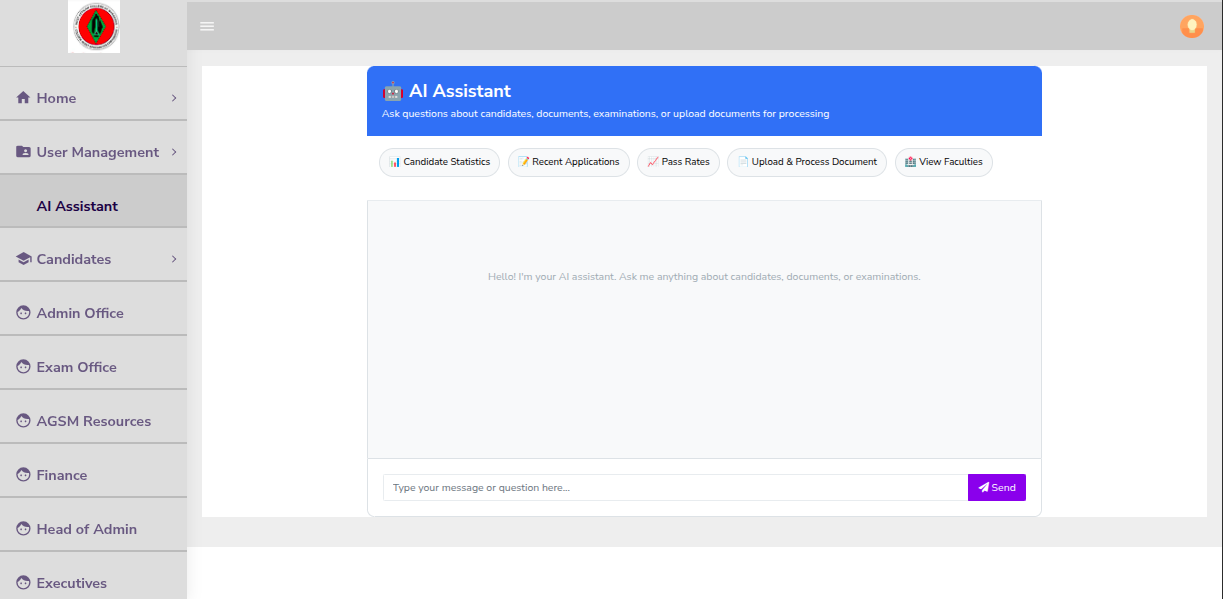
A full-stack enterprise web application built to digitize and manage the complete lifecycle of medical fellowship and membership examination records across West Africa. The system handles everything from candidate registration and application processing to examination scheduling, result management, document archiving, and AI-powered document analysis — replacing a previously manual, paper-based workflow for one of West Africa's most prestigious medical institutions.
The platform serves administrators, lecturers, and candidates with role-appropriate access while maintaining a complete audit trail of all operations across multiple countries, faculties, and surgical specialties.
Key Features
10 features built into this project
Challenges & Solutions
Technical problems encountered during development and how each was resolved.
Entity-as-config pattern: Rather than writing separate form and table views for each of the 32+ entity models, a single generic renderer reads metadata from entity classes (field types, labels, FK references, validation rules) and generates the UI automatically. Adding a new module became a configuration task rather than a development task.
Layered document extraction: Uploaded documents go through a waterfall extractor — pdftotext first, then Tesseract OCR for scanned PDFs, then Antiword for .doc files — ensuring maximum text coverage regardless of file format.
Multi-AI provider abstraction: The AI_Assistant library wraps OpenAI, Claude, and Gemini behind a single interface. The active provider is swapped via config, and costs are optimised by routing simple queries to cheaper models and complex ones to GPT-4o-mini.
More Projects
Other work in the PHP category
Advanced Hybrid Plagiarism & AI-Detection System (WACP)
An institutional-grade academic integrity platform that detects plagiarism and AI-generated content in student…
Charymeld Adverts Platform
A production-ready classified advertising platform built with Laravel 11, supporting a full three-sided market…
CodeSphere — LMS & Training Platform
A fully-featured Learning Management System (LMS) built with CodeIgniter 4 and deployed at training.teamodigit…